


Through our Actuarial Performance Management (APM™) Framework, MBE has collated industry insight into the operational performance of actuarial functions, and more specifically how that performance is managed. In this instance, we are not referring to individual employee performance, but more how the overall actuarial operational performance is managed. In line with MBE’s observations, the results have shown that the insurance industry is performing poorly on the key success factor “managing performance”. Why is this?
It always surprises us that even though actuarial teams perform a regulatory valuation four times a year, the valuation’s performance doesn’t appear to improve quarter on quarter. The issues experienced in one quarter simply continue to be a challenge in the next quarter, often with additional problems added. The performance is often a “feeling” of how each individual felt the valuation went, which of course can vary dramatically from one individual to another. But how do you change this? How do you improve an actuarial function’s performance?
Establishing the Actuarial Operational Performance Baseline
For starters, you need to do what every top-performing organisation or department does and that is to capture your baseline. You need to understand what your starting position is, then measure your next run and compare it to the baseline. Was it better than the baseline, or worse?
Capture the baseline of how an actuarial team is performing by identifying the individual tasks of the function and recording how much effort it takes to complete these tasks. You now have an “initial” state i.e. if everything goes as expected then it will take ‘x’ hours/days (this does not mean that this is the optimal state). The next tool we now need is the measurement tool. How do you measure these collective tasks during the quarterly valuation and how do you ascertain if the process has gone well or not?
The measurement could be as simple as – there were 20 tasks to complete today but only 17 have been completed. There is great value in knowing this information, as it immediately prompts questions around the process such as what happened? Why did it happen? And what needs to be done to resolve this for future periods? By measuring the performance and understanding how today went, we are able to plan for tomorrow (there might still be time to make tomorrow a success!).
When we do not measure operational performance, we lose this valuable insight and do not know when the team requires help. This measurement can mitigate the risk of the team going on a downward spiral. It is important to have this information on a real-time basis rather than at the end of the process, so support can be provided if and when necessary.
Implement KPI Tracking to Measure Operational Performance
Once you have the basic foundations in place, you have visibility of the individual tasks that the actuarial function performs and their associated effort, and you have started measuring the performance of each task. At this point, you can start to explore what key performance indicators (KPIs) you want to track the performance against.
At MBE Consulting our preferred and recommended KPIs are Quality, Cost and Delivery Time (QCD), as it ensures a well-rounded approach with each measure being linked to the others. If you focus on only one or two of these measures, then it can have a negative impact on the overall performance of the function. For example, if delivery time is the main measure without cognisance of quality and costs, then the quality of the deliverable can be severely affected and/or costs can increase given the intense focus on meeting the target delivery date. Similarly, if quality is the only measure, then delivery timescales would be impacted and /or costs can increase.
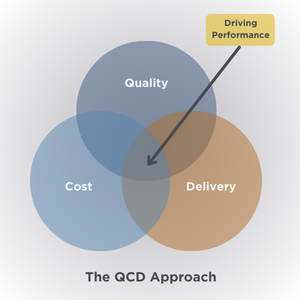
Quality is best measured as any deviation from the agreed standard.
Cost is the total expense involved in the delivery of the process.
Delivery measures the total elapsed process time from the data being received through to delivery to the customer.
As previously mentioned, measuring and tracking performance highlights when the process is not following the expected path and provides an opportunity to make timely rectifications. The measuring and tracking of KPIs also:

- Provides data for forecasts and future planning for the next valuation period.
- Highlights trends that will inform planning decisions.
- Provides a focus for continuous improvement.
- Identifies the problems and inefficiencies across the function.
- Shows where improvements can have the greatest impact.
- Allows for comparison and benchmarking.
Finally, remember that any measures that are implemented will affect people’s behaviours. The wrong measures can create unintended wrong behaviours. This is why we recommend focusing on team-based measures, as they encourage sharing best practices, creating a flexible workforce and eliminating work hoarding or cherry-picking. Measuring your team’s performance and having these measures tracked against the team KPIs means:
- Everyone is focused on the key team and business objectives.
- The team members help each other to achieve the common goal.
- The work is shared amongst the team for the best overall result.
- Improvement opportunities are raised & shared.
- Everyone benefits!
Need support with establishing and embedding operational KPIs within your actuarial team? Get in touch with our process management experts.
